Truth expressed in relationships in Titus and Philemon
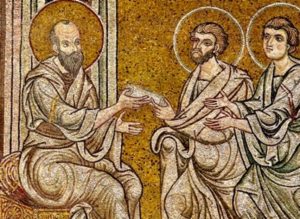 Nigh years I contribute to the Bible Reading Fellowship's (BRF) Bible reading notesGuidelines. Some time agone I wrote on 2 Timothy, Titus and Philemon, and share my thoughts equally the Pastorals, whilst the focus for certain traditions, are neglected past many churches in their teaching. Here are my notes on Titus and Philemon; see yesterday's post for my notes on 2 Timothy.
ane. Establishing God's people Titus i.1–fourteen
Paul follows the usual format of alphabetic character-writing in the ancient earth, only this one has an unusual introduction, like only to Romans in its focus. He commonly identifies himself as a 'slave' of God (or Christ) and an apostle or 'special messenger' of Jesus; the purpose of slaves and of messengers is not to drawn attention to themselves, but to serve and point to the ane who sent them. But here, Paul expands on his purpose in relation to those to whom he has been sent—to build upward God'south people in their religion, noesis of the truth and their promise, and that in turn is to shape godly living. As elsewhere, Paul emphasising that this is not of his choosing, but by the 'command' of God.
This focus is not surprising, given the reason for Paul's writing. Titus is not mentioned in Acts, just is referred to past Paul in his early (Galatians 2.1, 3) and later (2 Corinthians 2.13) writings. He was probably one of Paul'southward converts ('my true son') from a Gentile groundwork, and is not only a trusted partner in gospel ministry building (two Corinthians 8.23) merely also someone who can tackle hard pastoral bug (taking Paul'due south 'harsh alphabetic character' to Corinth, 2 Corinthians 7.12–15) and trustworthy with the collection for the Macedonians (2 Corinthians 8.5–7). It appears that, after Paul's release from the imprisonment at the end of Acts, he and Titus went to Crete and planted churches in that location, and Paul has left Titus to appoint local leaders. Paul is here not seeking to control what is happening, but to enable the delegation of shared ministry—not correcting bug, every bit in i Timothy, only putting leadership in identify to avoid them.
Although Paul just mentions men every bit elders ('of ane wife', v 6), we know from Romans 16 that he worked with women who shared his apostolic ministry (Romans sixteen.7). He recognises the importance of living an integrated life—a leader'southward adept standing amongst believers should reflect his competence as a leader in his ain household. 'Hospitality', literally 'the love of strangers', was a notable characteristic of the early on Christian community and a business concern of all (Romans 12.13, Hebrews 13.2, one Peter four.ix). In request leaders to be 'blameless', Paul is not asking for perfection, but that leaders should be mature in the faith, living distinctive lives in proficient standing with all, simply like the first believers in Jerusalem (Acts 2.47).
2. A healthy distinctiveness Titus 1.10–2.5
Although Paul is non trying to correct errors that have already crept into churches in Crete, he is enlightened of the possibilities of danger. Chief amid these threats are those 'of the circumcision [group]'. These seem to exist the ones who were arguing that to be a follower of (the Jewish saviour) Jesus, you needed to be circumcised too—something Paul believed undermined the sufficiency of Jesus' death and resurrection for united states, and compromised the offer of salvation to all, both Jew and Gentile. It was a major debate for the early church (Acts 15) and touched on a key part of Paul's understanding of the gospel (Romans one.16). Titus had already encountered this debate, since he was in Jerusalem with Paul, and his lack of circumcision was part of Paul'due south ain example (Galatians ii.3). For Paul, Jesus (and he alone) was the 'yep' to all God'south promises (two Corinthians 1.20–22), and nothing demand to exist added to the bulletin well-nigh him—and Paul was concerned that those whom Titus appointed would hold to the same good news. Paul'southward opposition to 'Jewish myths' (five fourteen) is no opposition to Jewish faith, or the Jewish roots of Christian faith; he consistently assumes that the Jewish Scriptures (the Old Testament) accept get the Scriptures of all followers of Jesus, Jew and Gentile alike.
Though it sounds harsh, Paul agrees with the Cretan philosopher Epimenides virtually the failings of his fellow countrymen (v 12)—only that could non depict all the island's inhabitants, else Titus would find no-i to appoint to leadership! Paul's business is rather that Christian leaders are shaped more by the fruit of the Spirit than by their surrounding culture, and that they pb distinctive lives that others should follow. This is quite the opposite to a bigoted legalism; the subject and self-control that comes with mature faith actually allows people to enjoy the liberty that is theirs in Christ ('To the pure, all things are pure', 5 15.) Paul hither uses a medical metaphor of 'good for you' didactics—translated in most English versions with the rather duller 'audio'—a word he uses frequently in the Pastorals and not in his other messages, but one which makes a connection with Jesus' own claims to be the one who brings spiritual health (Luke v.31). Healthy churches need healthy didactics from good for you leaders!
3. Winsome living Titus 2.vi–3.2
Information technology is like shooting fish in a barrel to feel frustrated that some of the ethical instructions in the New Testament don't sound a bit more radical. The apparent acceptance of slavery and the submission to what was in reality a violent autocratic arrangement of government seem too meek and mild and highly conformist—not just in comparison with contemporary Christian ideals only also compared with the radical ethics of Jesus. It is like shooting fish in a barrel to misread Paul'southward concerns in two directions—either rejecting them every bit a failed compromise, or accepting them as a universal agenda for social conformity.
But all letters in the New Testament are 'occasional'—written to people in a particular time and place. The early on Christian movement at this stage comprises mayhap ten,000 people in an empire of 14 meg, then challenging the structures of the status quo was non an choice. And this new way of life was a revelation—but it mustn't look likewise much like a revolution. Whatever movement which was seen to be threatening the social order would quickly exist put down by the Roman regime. The message of the gospel was indeed radical, just not in means we might realise. Information technology offers a radical involvement of all; groups (slaves, women and children) who might be expect simply to do as they are told are appealed to as active moral agents. If offers a radical blessing of all; the ethics here are full of concern for others and kindness to them. And information technology offers a radical promise—that we will see the full glory of God at the coming of Jesus our saviour (the best style of understanding v 13). He is the one who not only loves united states of america and accepts u.s., only effects the radical transformation of holiness in each of our lives.
Paul's consequent business is that this hope should be made available to all—hence the repeated refrain that 'they should have nothing bad to say about us' (v viii) and that 'the didactics near God our saviour [will be] attractive' (v x). There were enough of issues in which the early Christians were distinctive, not to the lowest degree their refusal to worship anyone other than Jesus, and Paul did not desire to add any unnecessary barriers. And it worked! Over the next 200 years, this tiny band grew faster than whatever religious motility in history until it took the empire captive.
four. Oh, what a gift! Titus iii.three–xv
The abrupt contrast that Paul has fatigued between the moral position of believers and those in wider club could hands give the believers a sense of superiority so that they looked downwardly on others—were information technology not for 2 things which Paul at present explores.
The beginning is that he is very clear that believers are, by their own efforts and in their natural state, no different from those around them. It is striking that Paul includes himself, a Jew, in the clarification of what 'at one time, we also were' (5 three). The listing of 7 faults are not but a thing of moral failure but of being spiritually 'enslaved'; we needed not simply educational activity but rescuing from bondage. And that rescue has been effected by the ane who 'saved' the states. The 'washing' alludes to water baptism which acts as a sign of the inner washing past the Holy Spirit. The language of 'rebirth' reminds u.s. of Jesus' teaching in John 3, that nosotros must be 'born again', but the particular term Paul uses hints at the new creation, the new globe that God'south anointed 1 brings into being. When we are born anew of water and the Spirit, nosotros begin to live the live of the age to come up—the meaning of 'eternal life'.
But the second thing Paul emphasises is that the change we have experienced is all God's doing—it is his 'mercy' and not our merit by which we take received this gift. In Paul'south day, gift-giving was governed by strict protocols; y'all gave a souvenir to a person who merited it by their worth, and the greater their worth, the greater the gift yous gave. But God turned that system upside-down in Jesus; the greatest gift of all has been given to those of no worth at all, only by the sheer kindness and generosity of the Giver.
Having received this gift, however, is merely the starting time. In the low-cal of God's generosity to us, we now seek to exist generous to others past 'doing what is skilful'. In that location is no point in Titus engaging in 'foolish controversies' that will not change anything; focussing on responding to God and sharing good news in discussion and deed will avoid the pitfall of living of 'unfruitful lives' (5 14).
5. Transforming relationships Philemon 1–eleven
It is perhaps surprising to observe i of Paul'due south personal letters in the catechism of the New Testament, especially as information technology does not appear to exist concerned with obvious issues of ministry, leadership or doctrine. But it is pregnant in giving us an insight into how Paul handled a difficult situation.
The commencement part of this short letter is dominated by Paul'south establishing of his strong relationship with Philemon before he turns to make his personal request. Luther called this letter 'holy flattery', and some have suspected Paul of being manipulative and underhand—but in fact the kinds of things he focusses on hither are present in his other messages. He deploys the linguistic communication of friendship and family unit (Apphia 'our sister' might well take been Philemon'due south wife) which he uses ofttimes elsewhere; having been born of the aforementioned heavenly Male parent, all those who believe are at present members of i family which transcends natural family ties. He too emphasises shared commitment and ministry; Philemon is a 'fellow worker', a term Paul uses for those who shared his apostolic ministry, who seems to be the leader of the Christian community ('church building' is too institutional a term for ekklesia) meeting in his abode. Another member of his family (peradventure his son?) is addressed as a 'young man soldier'; the imagery of fighting as a soldier is one that Paul and others use elsewhere (1 Corinthians 9.7, 2 Corinthians 10.3, Ephesaisn vi, 2 Timothy two.three, i Peter 2.xi).
But the theological basis of their relationship is matched by one of personal experience. Paul prays for Philemon, his family and his fellow believers, and 'constantly' gives thanks for them, as he does for many others (one Thessalonians one.2, Philippians 1.three, 1 Corinthians 1.4). It is typically that Paul's concern is both upward ('faith in the Lord Jesus') and outward ('love for all his people'), and that he sees discipleship non simply as having a decisive beginning but as too involving a standing journeying of 'deepening understanding'. And, also typically, Paul is reluctant to demand anything even when he would be entitled to do so; instead, he prefers to 'appeal to y'all on the basis of love'. The quality of relationships within the trunk of Christ are no mere brainchild for Paul, only brand a applied difference in the way that he relates to his brothers and sisters.
half dozen. The exercise of reconciliation Philemon 12–25
In past debates among Christians about slavery, both sides have appealed to this letter. On the one hand, Paul appears to accept the institution of slavery for granted, and offers no obvious objection to it. Afterwards all, up to one third of the population of the empire were enslaved, and an ending of the institution would have brought the social and economic structure crashing downward. And yet the language Paul uses hither challenges the very assumptions that brand slavery possible.
It appears equally though Philemon'southward slave Onesimus (whose name means 'useful') has run away ('separated from you', 5 xv), perhaps because he stole some money ('if he…owes you annihilation' v eighteen). He has met Paul, either by seeking him out or in his imprisonment, and has get a Christian through him ('my son' v 10). Paul's amore for Onesimus ('my very heart' v 12) outstrips fifty-fifty the warmth of his greeting to Philemon—but instead of seeking the freedom of the slave, or allowing him to become his own fashion, he seeks reconciliation between the two which will transform their relationship. The language of 5 xvi ('no longer a slave') is rather cryptic; Paul does non announced to be suggesting that Philemon should grant Onesimus manumission—setting him free—but does assume that the fraternal relationship between fellow believers will both transcend and transform the social human relationship that already exists.
This reconciliation involves at least three things for Paul. First, it means Paul making costly decisions to prioritise the reconciled relationship over his own needs and preferences. He would rather have kept Onesimus with him, as a support in his confined situation, than send him away. Only his commitment to Philemon means doing what is right by him. Secondly, it means Paul 'standing in the gap' and being ready to deport the cost of whatever it will take to restore the relationship and right what has gone wrong. Thirdly, Paul is committed to maintaining his relationship with both parties as they come up together with i another. Non merely does he emphasise his continuing partnership with Philemon (5 17), he also commits to coming to him again in person (five 22). For Paul, the reconciliation effected betwixt us and God through the death and resurrection of Jesus (2 Corinthians v.18–19) was not simply an useful idea or a handy metaphor—it was something that shaped his own life and relationships.
seven. Reflection
These two letters of Paul, with their attention to ii very dissimilar issues, have less of a sense of urgency most them, and less personal disclosure, But they are marked past Paul's continued business organisation for truth in pedagogy and truth in relationships.
Having entrusted to Titus the job of leadership among believers in Crete, he hopes that Titus will in turn discover people he tin trust and who are trusted in their own communities and contexts. It is no surprise, and then, that his focus is on graphic symbol rather than gifting, and on people for whom the transformative impact of the good news is existent and evident. But Paul is also concerned almost the truth of the doctrine and teaching that they receive, then that they can pass on to others what Paul himself received and passed on, first to Titus and (through him) to these others. The quite distinctive nature of Christian belief, and the way that it sets autonomously the followers of Jesus from their surrounding culture, means that it is all the more than important that there should be no unnecessary stumbling blocks to organized religion; leaders must nowadays no unnecessary obstruction that would distract from holding out the offer of life which they themselves have received. The renewing life of the historic period to come up must be lived out persuasively amongst those still living in this age which is passing away.
Christian truth volition only be persuasive when it is lived out in practice. Paul'southward exposition elsewhere of the reconciling power of the skilful news is expressed in his ain business organization for reconciliation between Philemon and Onesimus, when both might accept practiced reason to choose some other path. Paul is committed to rebuild relationships, even at price to himself—and the preservation of his personal letter is most likely testimony to the fact that what he longed for did in fact happen. Paul'southward concerns here have connected relevance to us. How can we brand certain we (and those effectually us) are rooted in salubrious teaching, and how can that exist expressed in healthy and health-giving relationships? How tin we communicated God's offer of reconciliation—and how can nosotros live information technology out in an ever-divided earth?
Do encourage your congregations and friends to appoint in regular Bible reading; BRF's notes are really valuable in encouraging thoughtful reflection and awarding.
If you enjoyed this, practice share it on social media, peradventure using the buttons on the left. Follow me on Twitter @psephizo.Similar my folio on Facebook.
Much of my work is done on a freelance basis. If you take valued this mail, would you considerdonating £1.20 a month to support the production of this blog?
If you enjoyed this, do share information technology on social media (Facebook or Twitter) using the buttons on the left. Follow me on Twitter @psephizo. Similar my page on Facebook.
Much of my piece of work is done on a freelance basis. If you lot have valued this post, you can make a single or repeat donation through PayPal:
Comments policy: Skillful comments that appoint with the content of the post, and share in respectful contend, tin add real value. Seek commencement to understand, and so to exist understood. Make the most charitable construal of the views of others and seek to learn from their perspectives. Don't view debate as a conflict to win; address the argument rather than tackling the person.
woolfbeheriseed83.blogspot.com
Source: https://www.psephizo.com/biblical-studies/truth-expressed-in-relationships-in-titus-and-philemon/

Post a Comment for "Truth expressed in relationships in Titus and Philemon"