What Percent of Family Farms in the Us
W hen the vast area of rural Iowa was carved up for settlers in the 19th century, it was often divided into 160-acre lots. 4 farms made a foursquare mile, with a crisscross of dead-straight roads mark the boundaries like a sprawling chess board.
Within each square, generations of families tended pigs and cattle, grew oats and raised children, with the sons most likely to have over the farm. That is how Barb Kalbach saw the hereafter when she left her family's land to marry and brainstorm farming with her new hubby, Jim, 47 years ago.
"When we very start were married, nosotros had cattle and calves," she says. "Nosotros raised hogs from farrow to terminate, and nosotros had corn, beans, hay and oats. So did everyone around us."
One-half a century later, Kalbach surveys the destruction within the section of chessboard she shared with other farms well-nigh Dexter in southwestern Iowa. Barb and Jim are the concluding family all the same working the land, after their neighbours were picked off by waves of collapsing commodity prices and the ascension of factory farming. With that came a vast transfer in wealth equally farm profits funnelled into corporations or the diminishing number of families that own an increasing share of the state. Rural communities accept been hollowed out.
And while the Kalbachs have hung on to their farm, they long agone abased livestock and mixed arable farming for the but thing they tin make money at any more – growing corn and soya beans to sell to corporate buyers as feed for animals crammed by the thousands into the huge semi-automated sheds that now dominate farming, and the landscape, in large parts of Iowa.
Kalbach comes from five generations of farmers and suspects she may be the concluding. Every bit she drives the roads around her farmhouse, she ticks off the disappearances.
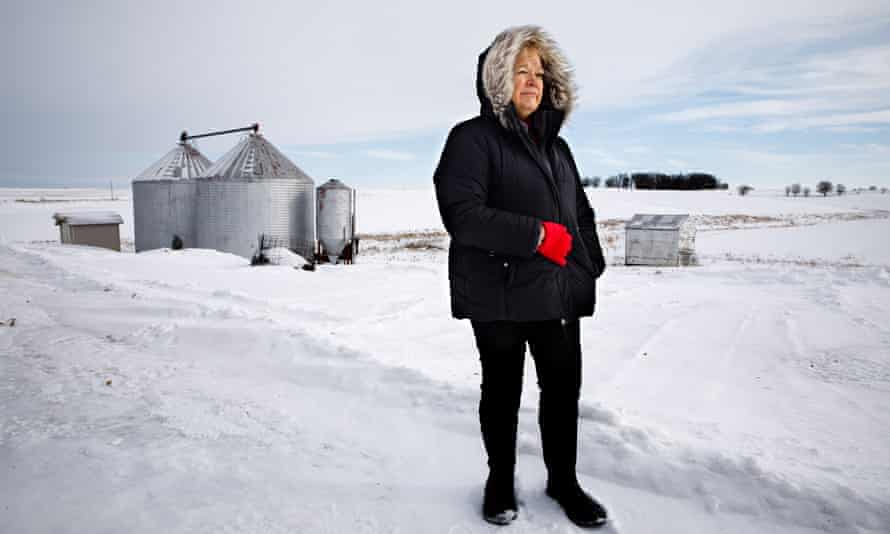
"That'due south the Shoesmiths' place," she said. "Two years ago, information technology had cattle, pigs and pasture."
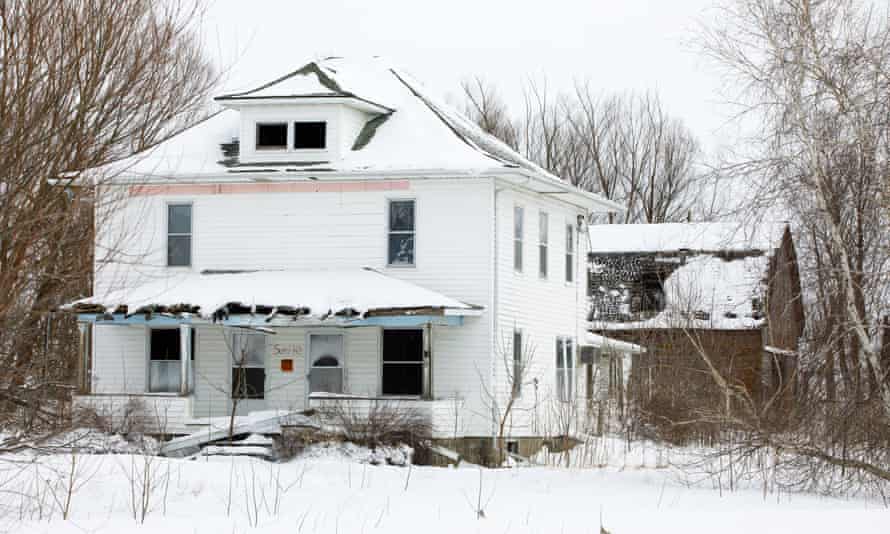
Now the land is rented out and is all given over to corn. A little farther along, the Watts family'due south farmhouse stands empty, its roof falling in. There are a few relics of the old farm at the place that used to be endemic past the Williamses – an abandoned hen house and a bit of mechanism – but the country is all corn and soya beans. The Denning house, on Walnut Avenue, was bulldozed subsequently the state was sold and rolled into a bigger operation.
Information technology'southward a story replicated across America'south midwest, with the rapid expansion of farming methods at the eye of the row over Usa attempts to erode United kingdom's food standards and lever open access to the United kingdom market as office of a post-Brexit trade bargain. Final weekend, the US ambassador to United kingdom, Woody Johnson, appealed to the United kingdom of great britain and northern ireland to cover U.s. farming, arguing that those who warned against practices such as washing craven in chlorine had been "deployed" to cast it "in the worst possible light".
His bulletin was greeted with acrimony by campaigners. Nick Dearden of Global Justice At present warned: "It is actually an creature welfare issue here. If U.k. farmers want to compete confronting American imports, they volition have to lower their standards or go out of business organisation." His words would come every bit no surprise to Rosemary Partridge, who farms in Sac County, western Iowa. She grew upward on an Iowa family subcontract so moved with her husband in the late 1970s to raise pigs and grow crops.
"In the past 20 years, where I am, independent grunter farming but silently disappeared every bit the corporates came in," says Partridge. "I live on a hilltop. I can see seven farm families, people my kids went to school with. They're all gone now. My county has 11 small-scale towns, and it's almost like I could look dorsum in slow movement and simply encounter the businesses modify and disappear. We've go poorer. Our communities are basically shattered and in more than just an economic manner – in a social way too."
This plummet has in good role been driven past the rise of concentrated creature feeding operations, or Cafos. In these industrial farming units, pigs, cows and chickens are crammed past the yard into rows of barns. Many units are semi-automatic, with feeding run by reckoner and the animals watched by video, with periodic visits by workers who drive between several operations.
"That's how I end up with 40,000 hogs around me," says Partridge.
Cafos account for simply a small proportion of America'due south 2 meg farms, but they dominate animate being production and have an outsize influence on crop growing, particularly in the midwest.
By ane calculation, the Us has effectually 250,000 factory farms of one kind or some other. They accept their roots in the 1930s, with the mechanisation of pig slaughterhouses. By the 1950s, chickens were routinely packed into huge sheds, in appalling conditions.
In the early 1970s, U.s.a. agriculture secretarial assistant Earl Butz pushed the idea of large-calibration farming with the mantra "become big or go out". He wanted to come across farmers cover what he regarded equally a more efficient strategy of growing commodity crops, such every bit corn and soya beans. Some farmers invested heavily in buying land and new machinery to increase product – taking on large amounts of debt to do and then.
A decade after, the farm crisis striking as overproduction, the Usa grain embargo against the Soviet Union and loftier interest rates dramatically collection up costs and debt for family farms. Land prices collapsed and foreclosures escalated."Every blow to independent farming made it more of an opportunity for large corporations to come up in," said Partridge.
In 1990, modest and medium-sized farms accounted for nearly half of all agricultural production in the U.s.a.. Now it is less than a quarter.
As the medium-sized family farms retreated, the businesses they helped back up disappeared. Local seed and equipment suppliers close up shop considering corporations went straight to wholesalers or manufacturers. Need for local vets collapsed. Every bit those businesses packed upwards and left, communities shrank. Shops, restaurants and doctors' surgeries airtight. People found they had to drive for an hour or more for medical treatment. Towns and counties began to share ambulances.

Corporate agriculture evolved to take control of the entire production line from "subcontract to fork", from the genetics of convenance to wholesalers in the United states of america or far due east. As mill farms spread, their demands dictated the workings of slaughterhouses. Smaller abattoirs, which offered selection and competitive prices to family farmers, disappeared, to be replaced by huge operations that were farther away and imposed lower prices on pocket-sized-calibration breeders such as the Kalbachs.
"By the time you paid to transport them the extra distance, and they were paying you less than they paid the corporations because you weren't bringing the big numbers, in that location was really no money in information technology," says Kalbach.
The buying power of the Cafos besides helps bulldoze farmers' decisions on which crops to grow. With no livestock, the Kalbachs were forced into gowing corn and soya beans to sell to factory farms as animate being feed or to corporations for ethanol.
Iowa is non lonely. Missouri, to the south, had 23,000 independent pig farmers in 1985. Today it has simply over 2,000. The number of independent cattle farms has fallen past xl% over the same flow.
Tim Gibbons of Missouri Rural Crisis Middle, a support grouping for family farmers ready during the 1980s farm crisis, says the wheel of economic shocks has blended with authorities policies to create a "monopolisation of the livestock industry, where a few multinational corporations control a vast majority of the livestock".
Gibbons explains: "They are vertically integrated, from animal genetics to grocery store. What they charge isn't based upon what information technology costs to produce, and information technology's not based on supply and demand, because they know what they need to make a profit. What they accept done, through government back up and taxpayer support, is to intentionally overproduce and so that the cost stays depression, sometimes beneath the price of production. That kicks their competition out of the market place. Then they become the but histrion in boondocks.
"Over time, it has extracted wealth and ability from communities. We can encounter how that has impacted rural chief streets. Yous can see the boarded-upwards storefronts. You can see the lack of economic opportunity."
Gibbons says that corporations game the arrangement by obtaining low-involvement, federally guaranteed loans to build Cafos that then overproduce. But they know the government volition buy upward the surplus to stabilise prices.

"The system has been set upward for the benefit of the manufactory farm corporations and their shareholders at the expense of family farmers, the existent people, our environment, our nutrient organisation," he adds.
"The thing that is really pervasive almost information technology is that they control the rules of the game considering they command the autonomous procedure. It's a blueprint. We're paying for our own demise.
"Information technology would be a different statement if it was just based upon inevitability or based on competition. But it's not based upon competition: it's based upon squelching competition."
There are well-nigh 70 million pigs in the U.s. at any time, most of them destined for the dinner plate. But one in ten are breeding sows, and the majority of those are in Cafos. The biggest pig farmer in the country is Virginia-based Smithfield Foods, which has near a one thousand thousand sows in the US (and more in Mexico and eastern Europe). Iowa Select Farms has one of the fastest-growing Cafo operations in the country, with 800 farms spread through one-half of the counties in Iowa.
Yet few of the economic benefits spill down to the communities around them. Workers are often poorly paid; many are bussed in. That they often include immigrants has sharpened the criticism from men similar Nick Schutt, who used to work at Iowa Select, driving pigs in livestock trucks and handling sows. He says he earned $23,000 a year for 12-hr days and no overtime.
"These companies claim they're creating all these jobs, but who's coming? Not people with families who create communities."
Schutt lives in Williams, a small town in central Iowa, which is surrounded by Cafos and currently fighting to keep a large new one out, maxim factory farms pollute the environment and depress holding values. When the wind blows in the wrong direction, the stench from huge lakes of hog manure wafts beyond the boondocks.
The high school Nick Schutt attended has airtight. His daughter was in the concluding class to graduate. As Williams declined, the only dr. close his clinic and left boondocks. Schutt's mother used to own a restaurant: that airtight forth with the boondocks's three grocery stores.
In Blairsburg, seven miles away, pretty much every shop except the post office is gone. The neighbouring hamlet of Wilke now consists of 3 animal sheds on land where dwellings were bulldozed from existence. Ii-thirds of the counties in Iowa, virtually all of them rural, take seen their populations decline since 2010, co-ordinate to the U.s. census.
Due north of Williams is a Cafo whose name, Quality Egg, has come to correspond the worst of factory farming. In 1988, New York temporarily banned the sale of its eggs after salmonella killed xi people. In 2017, its former owner, Jack DeCoster, went to prison, along with his son Peter, over a 2010 salmonella outbreak that made tens of thousands sick, left some with permanent injuries and prompted the recall of more half a billion eggs shipped from Iowa factory farms. Quality Egg pleaded guilty to selling eggs with false expiry dates and to bribing an agriculture department inspector to approve the sale.

DeCoster had a long history of paying fines worth millions of dollars for brute cruelty, falsifying records, swindling contractors and polluting – without much touch on the way he did business concern. He was found to have made immigrant workers, many of them in the United states of america illegally, live and work in squalid and dangerous atmospheric condition. The company paid $1.5m to settle allegations that supervisors at Iowa plants raped female workers.
DeCoster is an extreme case, but effectually Iowa he's seen equally emblematic of how the industry uses its money and influence to impose its will, including changing planning and environmental regulations.
Much of this is the result of agricultural corporations pouring millions into lobbying state governments. But Gibbons says Washington also bears some responsibleness. He accuses President Barack Obama's administration of failing to evangelize on promised reforms that would have benefited smaller farmers. It is this, he says, that damaged Obama'due south standing among farmers and drove up their support for Donald Trump.
Barb Kalbach is non optimistic nigh the future. Her son volition non be taking over the farm. She hopes the land will stay in the family for at least some other generation, but expects it to be rented out and subsumed into some larger functioning.
Merely Kalbach fears something bigger than the loss of her own farm. Farmers are ageing and their children either have little involvement in working the land or cannot beget the sophisticated equipment needed to compete with corporations.
"Investors buy the land, and they have tractors and combines that you tin run by computer," she said. "They'll hire somebody to sit in a little office somewhere and run that stuff off the computer and farm the land that mode. Now what you've done is you have lost the innate cognition of how to grow food and heighten animals. You've lost a whole generation of it, probably ii. Now we are going to rely on a few corporations to determine who is going to eat and who isn't. We're 1 generation away from that picture right at present."
In Williams, Schutt says he's seeing a community of owners becoming workers: "Information technology'south going to be like Russia with serfs. If you lot desire to piece of work on a subcontract, you'll have to work for them. We'll give you a job, but you're going to be working on our terms. We control everything. Small farms tin can't survive."
Kalbach agrees. "I think they're done," she said.
woolfbeheriseed83.blogspot.com
Source: https://www.theguardian.com/environment/2019/mar/09/american-food-giants-swallow-the-family-farms-iowa

Post a Comment for "What Percent of Family Farms in the Us"